
Our core product. Both eyes at 180 Hz, wearable anywhere, with AI LMOT live object recognition included, and add-ons that extend it: ET3Space, the Stationary Scene Camera, and EEG TTL Sync.
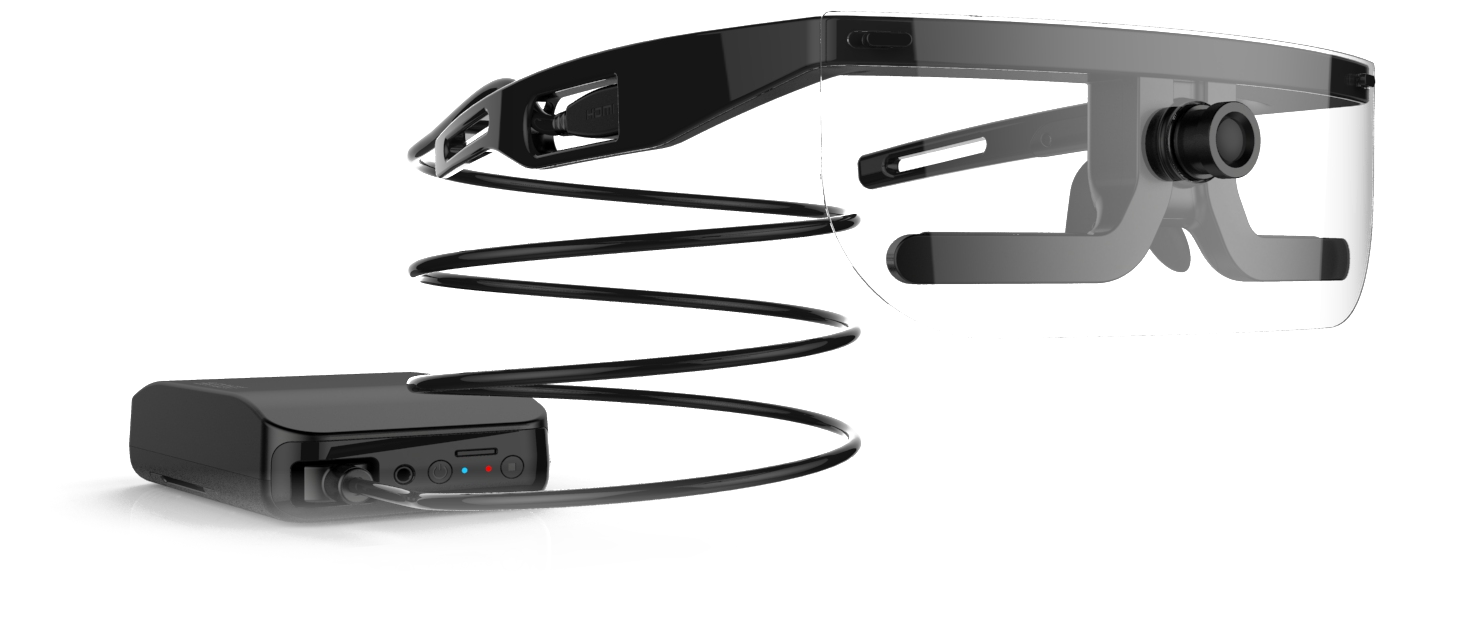
Two capabilities define ETVision: true 3D gaze and AI LMOT (Live Multiple Object Tracking). Together they specify attention precisely, with respect to real objects, in real time, and in real space.
Real vergence data (vergence angle and gaze convergence point) in three dimensions are solved from both eyes as geometric computation.
A standard 80-object AI model ships with every system. Train custom AI models on your own objects with the AIObjectTraining add-on. And ETVision names what the wearer looks at, live on the platform.
THE DEAL BREAKERS, ANSWERED
Worn over the participant's own glasses, progressives included. No special lenses, and nobody is excluded.
Gaze is solved by geometric computation, and both eye videos are recorded at 180 fps. Replay frame by frame, or recalibrate after the fact. Not a black box.
Processing runs on your local system. No public cloud in the path, and no account.
ALSO BUILT IN
With the ET3Space add-on, ETVision turns eye tracking into true spatial computing signals.
Output real-time ("Live") Bar Plots of object-grounded human attention distribution.
Tight enough to tell one instrument from the next, in cockpits, control rooms, and operating rooms.
Track the outline of an object in real time and report Gaze Position with respect to a monitor, a phone, or any defined object.
TTL sync pulses precisely line up ETVision data with data from EEG and other instruments, with the EEG TTL Sync add-on.
Run calibration, view live video, and control recording from an iOS or Android phone. No cable needed.
Eye tracking for athletes skiing, cycling, or other activities in the wild.
The software comes with the system, with all future updates. No annual fee, in year one or year ten.
The capabilities that matter when a result has to survive review.
| Gaze accuracy | 0.5° binocular, with calibration |
| 3D gaze & Vergence | Yes, solved as geometric computation, auditable |
| Spatial gaze in real-world frame | Yes, with ET3Space and motion capture |
| Multi-object tracking | Yes, on AI models you train yourself |
| Live attention | Yes, real-time Bar Plots of object-grounded human attention distribution |
| Over prescription glasses | Yes, no special lenses |
| Eye video | Both eyes recorded at 180 fps, replayable frame by frame |
| Data safety | Processed on your local system, no public cloud required |
| Origin | Designed, built, and supported in the USA |
When a result has to survive review, verification is not a feature. It is the point.
The essentials. The full ETVision specification is in the Download Center, and common questions are answered in the ETVision FAQ. Manufacturer's specifications, last verified 15 October 2026.
| Technique | Dark pupil, corneal reflection |
| Binocular | Yes |
| Rate | 180 Hz |
| Accuracy | 0.5 degrees |
| Calibration | Auto in about five seconds, single-point, or multi-point |
| Object tracking | AI LMOT (80-object model included) and live areas of interest |
| Eye video | Both eyes at 180 fps |
| Scene video | 1080p at 30 fps, with microphone |
| Battery / recording | 4+ hours |
| Storage | 128 GB microSDXC card included; cards up to 400 GB |
| Prescription glasses | Compatible |
| Weight | Optics 56 g; controller 345 g with battery |
| Parallax Compensation | Yes |
| Slippage Compensation | Yes |
| Outdoor use | Yes |
At 180 Hz: point of gaze on the scene image, gaze direction, fixations, blinks, eye locations, gaze vergence, pupil diameter from an ellipse fit, eyelid position, and gaze engagement with AI-detected objects or live areas of interest. All of it streams over the network and records to file. Recording can be triggered from an external device.
Used in defense and aerospace, flight and rail simulation, surgical robotics, medicine and radiology, neuroscience and pharmaceutical research, control rooms, automotive and driver monitoring, sports performance, and robotics research. See applications.
How gaze is placed on real objects in a room, and what a world model has to contain for that to work.
Eight questions that decide which wearable eye tracker fits a study, including the cases where the answer points elsewhere.
What comes with the system, how gaze is computed, recording time, data, synchronization, and support.
We will show ETVision on a task close to your own, and answer every technical question.
Schedule a demo